1. Introduction – Why Your Choice of Coin Matters
On Betida, you can use several different cryptocurrencies for both casino games and sports betting.
From a pure game perspective:
- Game math,
- RTP percentages,
- Markets and features
do not change based on which coin you use. There is no such thing as “higher RTP if you bet with BTC”.
However, your coin choice matters a lot for:
- How you track your bankroll,
- How much price volatility you are exposed to,
- How you feel psychologically about wins and losses,
- Fees and transfer speeds.
This guide helps you make a more informed choice between stablecoins and other cryptocurrencies when betting on Betida.
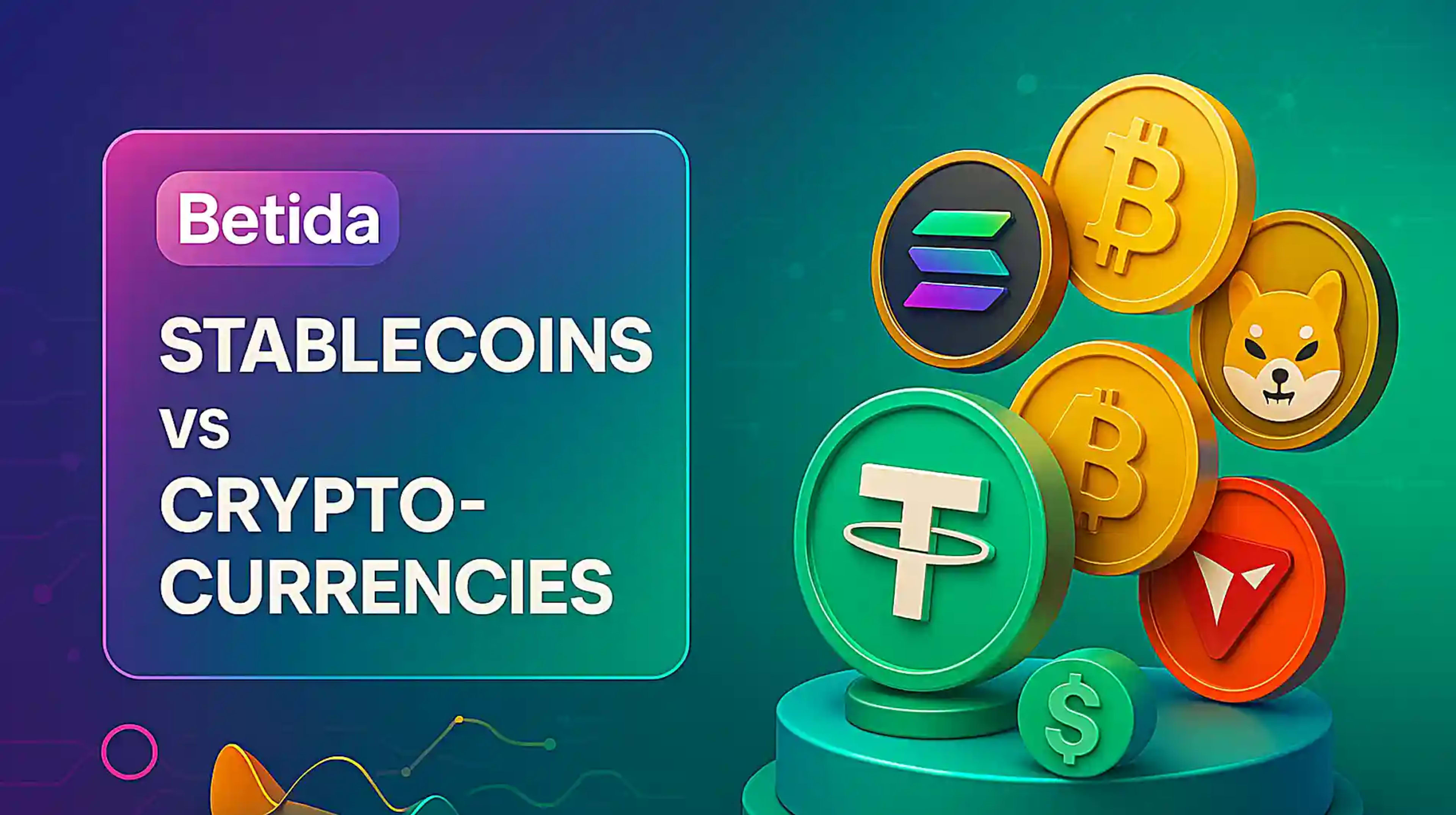
2. What Is a Stablecoin? (USDT, USDC, BUSD, etc.)
A stablecoin is a crypto asset that aims to keep its value close to 1 unit ≈ 1 USD (under normal conditions).
Examples:
- USDT (Tether)
- USDC (USD Coin)
- BUSD (depending on the exchange/infrastructure)
Key characteristics:
- The price is designed to remain relatively stable (excluding extreme market events).
- It makes moving value between platforms simpler and more predictable.
- It makes bankroll management feel more like managing traditional fiat.
For example:
- If you have a balance of 200 USDT, you can mentally treat it as “about 200 USD”.
- This makes it easier to say “I won’t risk more than 300 USD this month” and stick to it.
3. Other Cryptocurrencies (BTC, ETH, SOL, TRX, SHIB, DOGE, etc.)
Everything that is not a stablecoin can be treated as a volatile coin.
Examples:
- BTC, ETH, SOL, TRX, XRP, LTC, BNB, EOS, UNI, LINK, APE, SAND, POL
- SHIB, DOGE, TRUMP and other meme / high-risk coins
For these assets:
- Prices can move up or down very quickly, even in a single day,
- Your exposure is not only to game outcomes, but also to market movements,
- Your balance in fiat terms can change even while you are not betting.
Example:
- You have 0.02 BTC.
- If BTC price rises, your balance in fiat terms can increase even if your game results are flat.
- If BTC price falls, you may win some bets, but still see little or no net gain in fiat terms.
4. Comparison from a Betting Perspective
4.1. Bankroll Tracking
Stablecoins:
- Because 1 USDT ≈ 1 USD (in normal conditions),
- Monthly/weekly budgets are easy to define in clear numbers,
- “I won’t risk more than 200 USD this month” is simple to measure and follow.
Other cryptos:
- BTC/ETH/SOL, etc. move in price constantly,
- The same coin amount can have different fiat values on different days,
- If you care about fiat budgets, you must also track fiat equivalents, not just coin amounts.
Conclusion:
For players who want clean, simple bankroll tracking, stablecoins are usually more practical.
4.2. Volatility (Price Fluctuation)
Stablecoins:
- Volatility is relatively low; the token aims to stay around 1 USD,
- Outside of extreme stress events, you don’t expect large swings.
Other cryptos:
- BTC, ETH, SOL, TRX, SHIB, DOGE and others can move in double-digit percentages within days or even hours,
- On top of game risk, you carry market risk.
Conclusion:
If you want to minimize price volatility, stablecoins are more suitable.
If you are comfortable with market swings and see them as part of your overall risk, volatile coins may be acceptable.
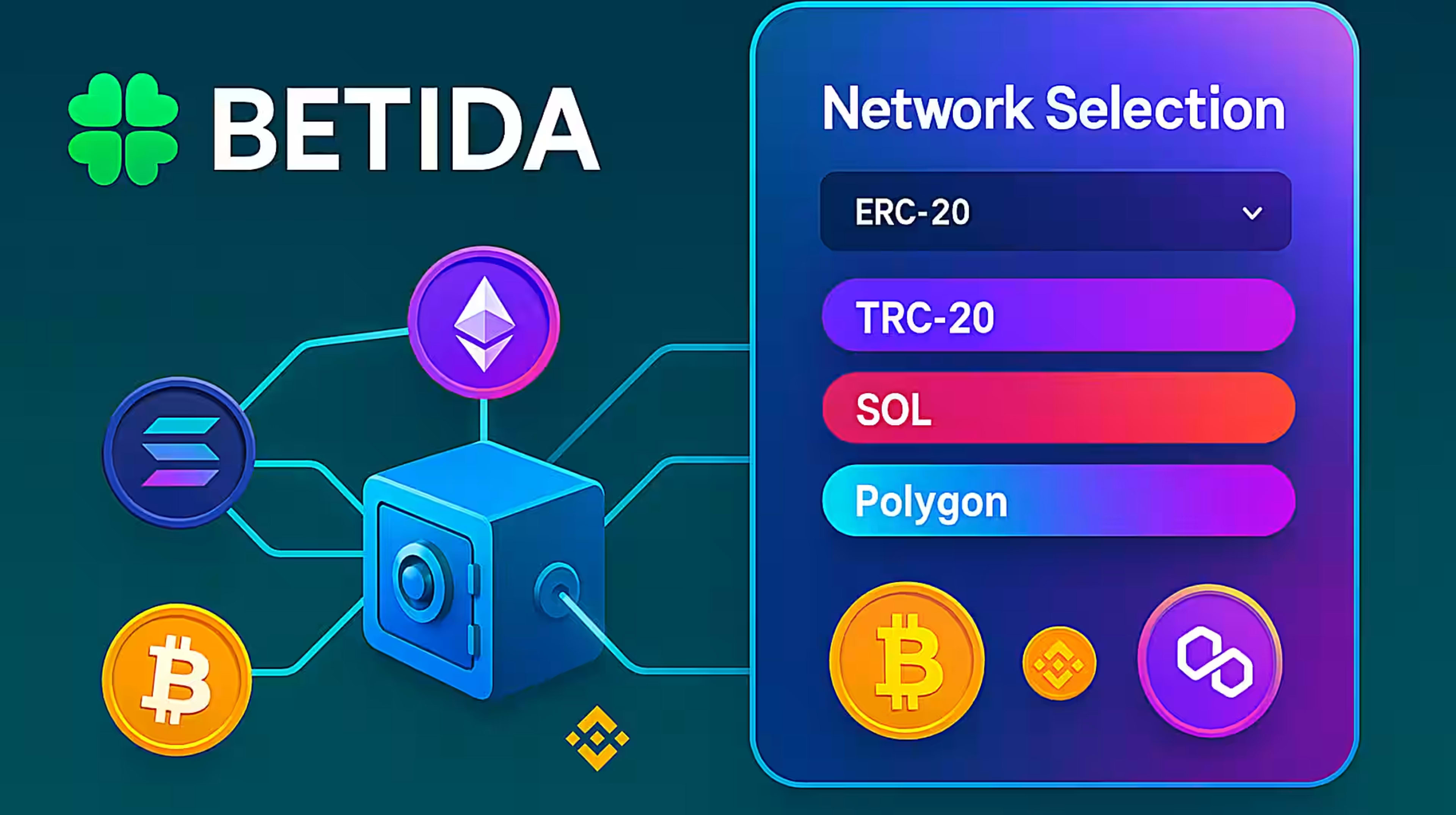
4.3. Fees and Network Design
Here, the critical factor is not only the coin but also the network (blockchain) you are using:
- USDT-ERC20 vs USDT-TRC20 can have very different fees,
- A BTC transfer is not the same as a TRX or SOL transfer in terms of cost and speed.
In general:
- TRX, SOL and similar networks tend to be faster and lower-cost,
- Ethereum mainnet (ERC-20) can be more expensive, especially during congestion.
Regardless of stable vs volatile, when depositing to Betida you should:
- Choose both coin and network carefully,
- Review fees on the confirmation screen before sending.
4.4. Psychology and Behaviour
Betting with stablecoins:
- Wins and losses are seen directly in money-like units,
- Many players find this clearer and more comfortable for responsible bankroll management.
Betting with volatile coins:
- You might think “I’m holding this coin anyway; I’m just playing with it”,
- Rising prices can create extra confidence, falling prices extra stress,
- The emotional impact of swings can be stronger, especially with meme coins.
There is no single “right” answer; the key is:
- Knowing your own risk tolerance,
- Using a Betida Smart–style approach: pre-defined limits and disciplined bankroll rules.
5. Which Coin Makes Sense for Different Player Types?
These example profiles are just a general framework:
5.1. Budget-Focused Player Who Wants Clear Limits
- “I don’t want to risk more than 300 USD this month.”
- “I want to clearly see how much I’ve spent and won.”
Suggested approach:
- Focus on stablecoins like USDT / USDC / BUSD,
- Set all limits (daily/weekly/monthly) using these coins and their approximate fiat value.
5.2. Player Who Both Bets and Holds Crypto Long Term
- Already holds BTC, ETH, SOL, TRX, etc.,
- Sees Betida as “a place where I also use my crypto”.
Suggested approach:
- Define the amount assigned to Betida as a small, fixed percentage of total crypto holdings,
- If betting with BTC/ETH/SOL, fully accept the combination of game risk + price risk,
- Optionally, use a mixed setup:
- A core bankroll in stablecoins,
- A smaller side bankroll in volatile coins.
5.3. High-Risk / High-Excitement Player
- Used to SHIB, DOGE, TRUMP and similar meme / high-volatility coins,
- Views market swings as extra adrenaline on top of the games.
Suggested approach:
- Keep the bankroll used with these coins as a very small percentage of total holdings,
- Maintain most of the overall bankroll in stablecoins or more established assets,
- Treat meme/ultra-volatile coin betting as a high-risk sandbox, not as the core bankroll.
5.4. Occasional Player
- Logs in a few times per month,
- Does not want to monitor crypto prices constantly.
Suggested approach:
- Use stablecoins for simple in/out:
- Deposit what you plan to play,
- Withdraw when you’re done,
- This keeps both volatility and “how much did I actually spend?” confusion lower.
6. Using Betida Smart Alongside Your Coin Choice
The Betida Smart philosophy applies regardless of which coin you use. It focuses on:
- Defining a clear budget in advance (ideally in fiat terms),
- Splitting that budget by time, game type or coin,
- Risking only a small percentage of your bankroll per bet or spin (e.g. 1–3%),
- Reducing stakes or pausing when you hit a losing streak,
- Periodically reviewing both game results and coin price movements.
Stablecoins make this model easier to read, while volatile coins add an extra market-risk layer. The important thing is that, whatever you choose:
- You make that choice consciously,
- You do not exceed your pre-set limits,
- You stay aligned with responsible gambling principles.
7. Quick FAQ
Do I have to use stablecoins to bet with crypto?
No. Betida supports multiple cryptocurrencies. You can use stablecoins or other coins such as BTC, ETH, SOL, TRX, etc. The choice depends on your risk profile and preferences.
Is it “safer” to bet with stablecoins?
In terms of price volatility, yes – stablecoins generally carry less price risk.
In terms of game risk, the odds and RTP do not depend on the coin.
Will I earn more if I bet with BTC or ETH instead of stablecoins?
Game RTP and rules are the same regardless of coin. Betting with BTC/ETH adds potential price gains or losses on top of game outcomes, but this is a market risk, not an inherent bonus.
Which option is “best”?
There is no single “best” choice.
- For clear and simple budgeting: stablecoin-heavy setup is often best.
- For experienced crypto holders comfortable with volatility: BTC/ETH/SOL, etc. may feel natural.
The key is to align your coin choice with your bankroll limits and expectations.
8. Summary
On Betida, your choice of coin:
- Does not change game rules or RTP,
- But has a big impact on your bankroll management, price exposure and psychology.
In short:
- Stablecoins (USDT, USDC, BUSD)
- More stable value,
- Easier bankroll tracking,
- Lower price-volatility risk.
- Other cryptos (BTC, ETH, SOL, TRX, SHIB, DOGE, etc.)
- Higher volatility,
- Game risk + market risk together,
- More attractive for users who already trade or hold crypto and accept price swings.
Whichever you choose:
- Set your budget first,
- Follow Betida Smart principles and stick to your limits,
- Choose your coin and network carefully so the technical side remains controlled while you focus on the actual experience — your games, your bets and your long-term bankroll.